Service boundary
Respect thermostat input, temperature limits, event duration and recovery time.

Precision load coordination designed to reduce peak pressure while preserving essential customer service.

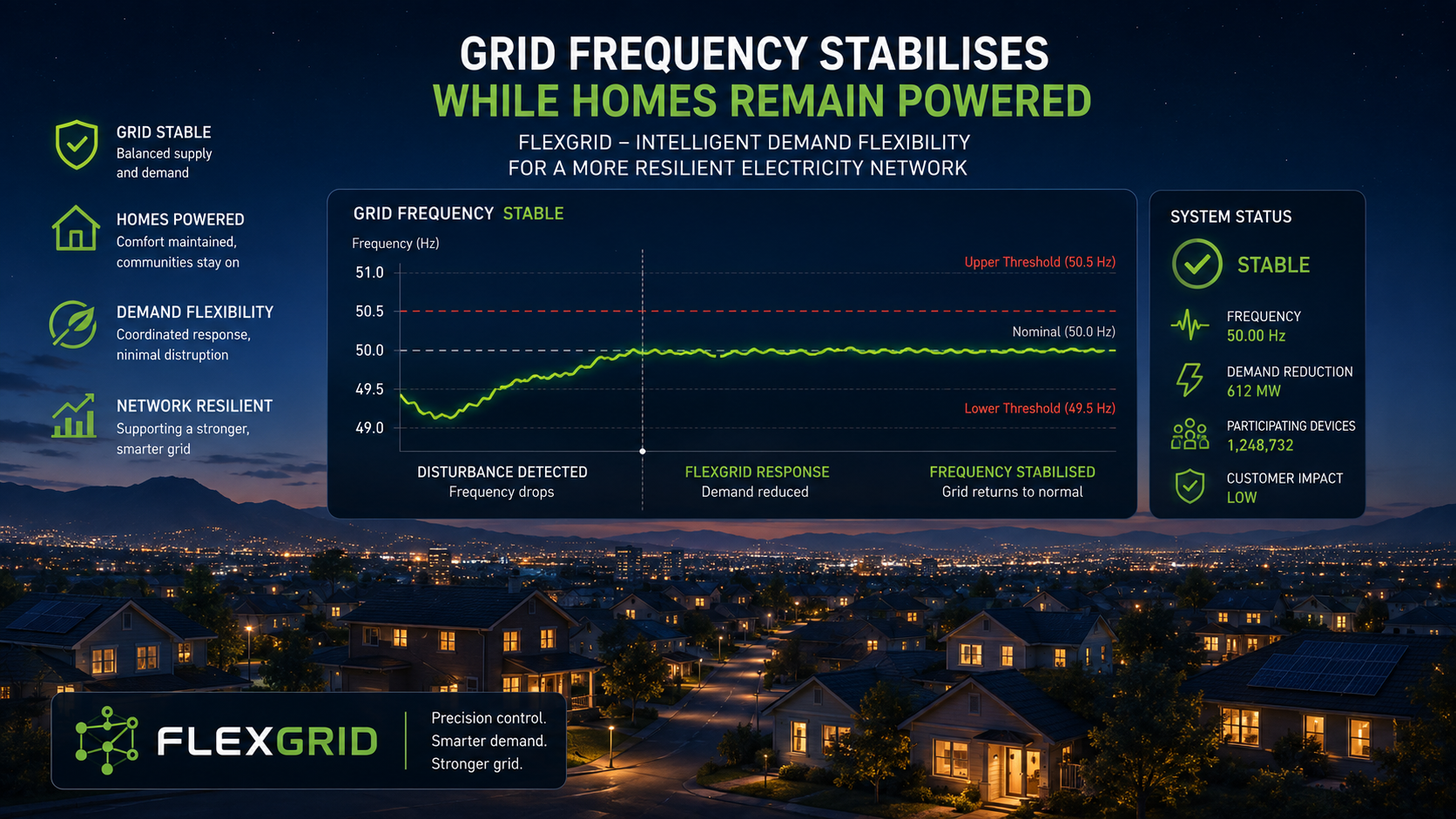
Discover how FlexGrid intelligently manages electrical demand, improves network resilience and enables a smarter, more responsive energy ecosystem.
FlexGrid builds on intelligent cycle management and distributed control to create a more granular response to grid stress.
Each stage must be configured for the responsible utility or system operator and verified against a pre-agreed measurement method.
Local hardware monitors frequency, device state and fleet availability.
Approved policies set eligibility, scope, duration and aggregate limits.
Eligible devices respond in diversified, manageable cohorts.
Telemetry and metering quantify response and exceptions.
Staggered restoration reduces the risk of a secondary demand peak.
Authorised evaluators can sign in with the User credentials supplied by PowerPulse Nexus to follow grid frequency, demand, flexible-load response and the staged adjustments made during an event.
Credentials are issued separately and are never displayed on this public page.The source design combines local frequency measurement, zero-crossing switching, adjustable cycle limiting, wireless connectivity and PowerPulse Nexus dashboards.
Respect thermostat input, temperature limits, event duration and recovery time.
Record consent or contractual authority and provide approved override or opt-out routes.
Limit simultaneous switching and enforce ramp limits.
Authenticate commands and retain acknowledgements.
Apply an approved local fallback without extending events indefinitely.
Restore load in stages while monitoring rebound.
FlexGrid should be evaluated as an aggregator of available capacity.
Installed devices × event-eligible share × active-load share × successful activation share × verified kW reduction ÷ 1,000
Every factor must be time-, location- and event-specific.FlexGrid does not replace generation, storage, network investment or system-operator controls. It does not guarantee fixed capacity, a frequency outcome, savings or avoidance of load shedding.
Agree the service, authority, safeguards, baseline and acceptance criteria.